Client Case Study

Bella Pizzahh SEO Case Study

Flat for Nine Months, Then 732K Impressions

Independent pizzeria, New Jersey

Search Console, year ending 21 August 2026

Bella Pizzahh is an independent pizzeria in Hasbrouck Heights, New Jersey. Through the year this case covers it stayed a single restaurant with a single kitchen, opened no new location and bought no new advertising. The only thing that changed was how much of its own subject the website covered. In Search Console the result reads as a step rather than a gradual climb.

The figures are twelve months of Google Search Console to 21 August 2026, published with the screen by our founder on nizamuddeen.com. This page tells the same story in ORM’s words, with the same numbers.

Nizam Ud Deen - SEO Observer
Nizam Ud Deen

CEO @ ORM Digital Solutions
(SEO Specialist)

10+ years experience

The Numbers at a Glance

Google Search Console, twelve months to 21 August 2026. One restaurant, no paid traffic in the mix.

732K Impressions

Across the twelve months, most of them arriving after the coverage build landed in late May.

6.5K Clicks

Visits from search over the same year, from a site that used to appear for its own name and hardly anything more.

Position 9.8

Average position across every query the site was shown for, the foot of page one.

Late May

The month the pages went live and the impression line stepped up for good.

0.9% CTR

Click-through across the year, and why a coverage build makes that number look low at first.

One Kitchen

Nothing about the business changed. No new branch, no ads, no new menu. The coverage did.

Round-Logo
What It Shows

What This Case Shows

Most local businesses are not losing on rankings; they are absent from the searches entirely, because a query with no page behind it cannot rank at all. Bella beat nobody at optimisation. It began appearing for searches that had never had a page, and the chart moved in the same month.

  1. Coverage before optimisation. Adding pages for uncovered searches produces a step in Search Console; polishing existing pages produces a slope.
  2. Sort the searches by who can win them. National recipe sites own the broad terms, so those became feeder pages; the local commercial terms became the money pages.
  3. One page per town beats one page listing the towns. Each carries its own landmarks and a single clear ordering route.
  4. Seasonal, local, uncontested demand exists. People searched for the tournament at the stadium nearby, and no local business was answering.
  5. Read the shape, not the totals. A flat line that steps up is the signature of coverage arriving.
Bella Pizzahh case study card: independent pizzeria in Hasbrouck Heights, New Jersey

The Restaurant and the Real Problem

Bella had the reviews and the reputation of a good local pizzeria and a website that search barely noticed: it appeared for its own name and hardly anything else. Around it was specific, steady demand from the Meadowlands towns: delivery searches, catering enquiries, people looking for one particular dish, and crowds wanting somewhere to eat around events at the stadium three miles up the road.

  • A single restaurant in Hasbrouck Heights, with delivery across the surrounding towns
  • Strong reviews, so the business was not the weak point
  • A website that answered almost none of the searches happening around it
  • No page, therefore no ranking, for delivery, catering, dishes or event-day searches
  • A stadium three miles away producing seasonal search demand that nobody local answered

The problem was not rankings. The site had never entered the running for those searches, because it had no pages for them.

Mapping the Topic Before Writing

Before a word was written, everything a person near this restaurant might type into search was listed and sorted by who stood a realistic chance of winning it.

  • The broad informational terms are owned by national recipe publishers and the big chains, so those pages were built to sit at the top of the funnel and pass links downward
  • The local commercial terms could be won, and those became the pages that take orders
  • Delivery, catering and dish searches were grouped by the town they came from
  • Event-day demand around the stadium was mapped as its own seasonal cluster
  • Each informational page was paired with an ordering page to link down to, so visitors always had a next step

The map decides the order of work and the shape of the site. It is the difference between a menu with an address and a site that covers its subject.

Card: map the topic first, then sort by who can win
Card: a local layer and an informational layer

The Local Layer and the Informational Layer

Two layers were built. The local layer earns the orders; the informational layer earns the authority that lets the local layer rank.

  • One page per delivery town instead of a single page that names them all
  • Every town page with its own landmarks and neighbourhoods and a single obvious way to order
  • The Google Business Profile pointed at the same searches as the pages
  • Links from each town page to the menu, the catering page and the towns next door
  • A broad set of recipe and food pages, with event pages timed to the tournament, each one sending readers down to the ordering pages

The informational pages exist to be read, and to send their readers and their link value toward the pages that take orders.

Free Audit Call

Could Your Site Do the Same?

Book a free 20 to 30 minute call on Zoom, Google Meet or WhatsApp. We look at your site, your Search Console and the businesses ranking above you, then tell you what would move first.

Prefer to talk now? Call +92 300 6456323. Quotes are shared on WhatsApp once we have seen your numbers.

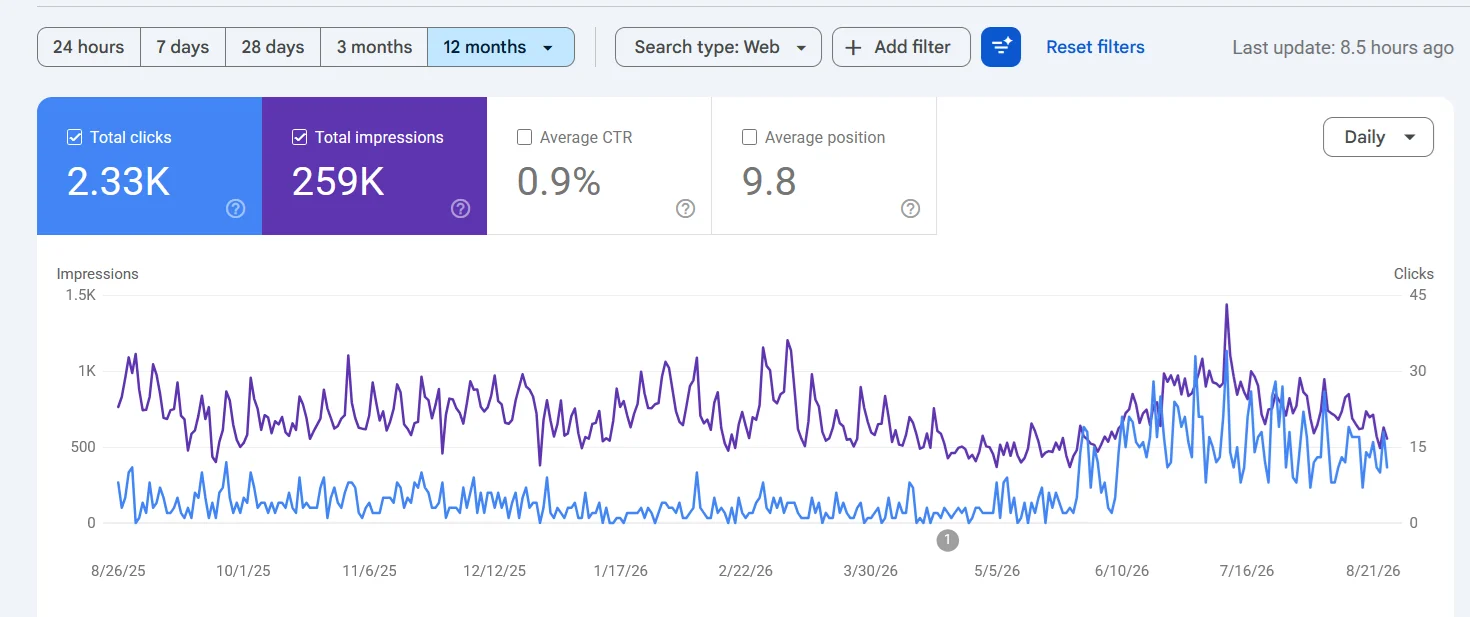
The Evidence: A Year in Search Console

Beside this section: Google Search Console for the twelve months ending 21 August 2026. The shape matters more than the totals.

  • Across the year: 732K impressions, 6.5K clicks, average position 9.8
  • From late August until early May the line barely moves
  • In the second half of May it jumps, and it stays at the new level to the end of the window
  • Tuning existing pages gives a slope; new pages for uncovered searches give a step
  • Nothing else changed in the business during those twelve months

This is the Search Console signature of a coverage build. The month the pages landed is the month the chart turned.

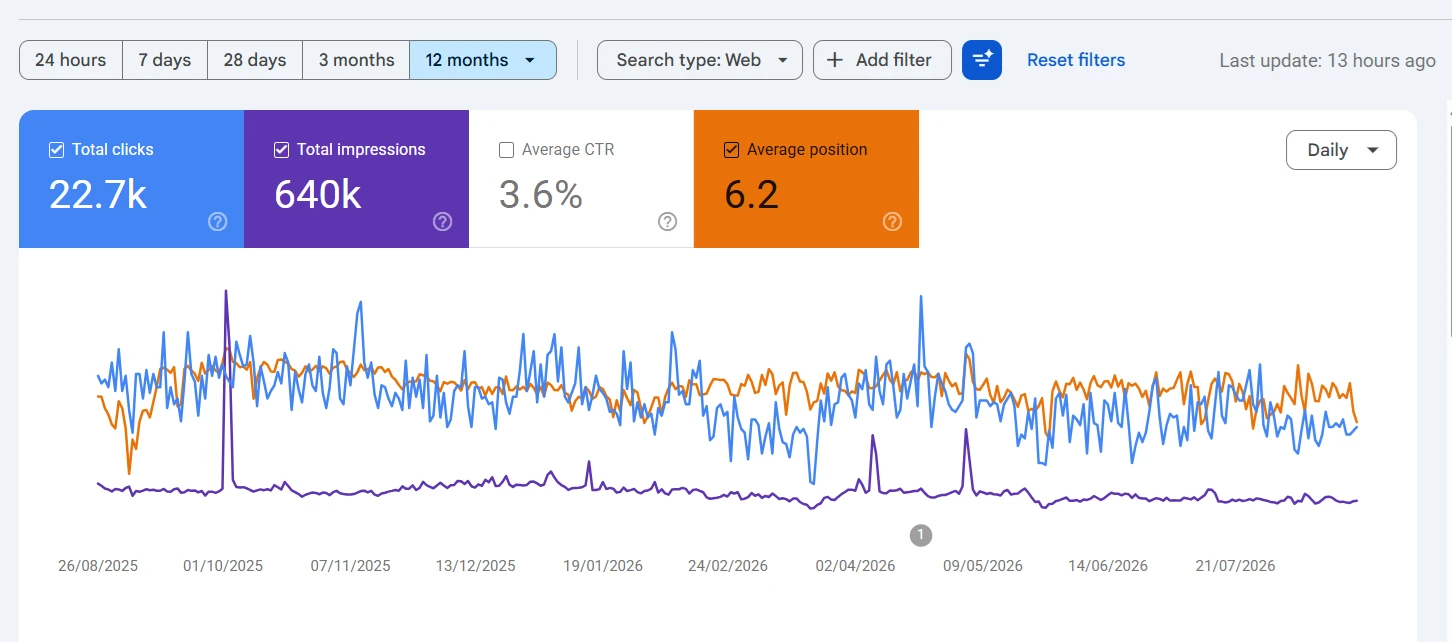
Google Search Console, twelve months to 21 August 2026: 732K impressions, 6.5K clicks, the line steps up in late May
Card: 0.9% click-through across the twelve months

Reading the 0.9% Click-Through

The year’s click-through rate is 0.9%. That number is a direct result of the approach rather than a weakness in it, and we would rather explain it than leave it off the page.

  • When a site starts being shown for hundreds of thousands of queries it never appeared for before, it sits low on the page for nearly all of them to begin with
  • Reach comes first; positions catch up later
  • Measuring a coverage build by its first months of click-through is like measuring a new shop by its opening week
  • The reach had to exist before anything could be done with it; ranking work needs impressions to act on
  • As positions improve on the new queries, the click-through follows

Reach first, positions second, clicks third. This page is a record of the first stage completing.

What It Means for Other Local Businesses

If your site ranks for your name and little else, the fix is rarely more optimisation of the pages you have. It is pages for the searches you do not have.

  • Map what people near you search for, and sort it by what you can realistically win
  • Give every town, every service and every seasonal event its own page
  • Keep the Google Business Profile pointed at the same intent as the pages
  • Build the informational layer to feed the commercial one, never the other way round
  • Expect a step, then work the positions on the reach you built

We do this for restaurants on our restaurant SEO page and for every local trade through the Local SEO service.

Card: 732K impressions in twelve months, 6.5K clicks, average position 9.8

We are here to answer all your questions

Questions about this case study.

No. One location, one kitchen, no new advertising and no new menu. The only variable in the twelve-month window was the website’s coverage of its subject, which is what makes the chart readable.

Because pages were added for searches that previously had no page on the site. Search Console cannot show a ranking for a query you were never in the running for, so when those pages landed in late May the site entered hundreds of thousands of new searches at once.

Not at this stage. A site that has just started appearing for a great many new queries sits low on the page for most of them, so impressions multiply faster than clicks. The reach had to exist first; the ranking work that lifts click-through acts on that reach.

A complete local layer with a page per delivery town, plus a wide set of recipe and food pages and the event coverage above them. We do not quote a page count because the number is not the point: the coverage of the subject is, and that depends on the business.

Yes. A restaurant in Lahore or Multan has the same pattern: people search for delivery, for a dish, for a place near a landmark or an event, and most restaurant sites have a menu and an address and nothing else. Our restaurant SEO page describes the same method for Pakistani cities.

Google Search Console for the restaurant’s site, twelve months to 21 August 2026, published with the screenshot by our founder at nizamuddeen.com. Same figures here, ORM’s wording.

Ranking for Your Name Only?
Let us Map the Rest!